

Getting your workspace ready is just as important as choosing the right pieces. Whether you’re setting up a corporate office or a home workstation, proper planning before your office furniture installation begins can save hours of frustration, prevent damage, and ensure a smooth setup from day one.
This guide walks you through everything you need to prepare — from space measurement to team coordination — so your delivery and assembly go off without a hitch.
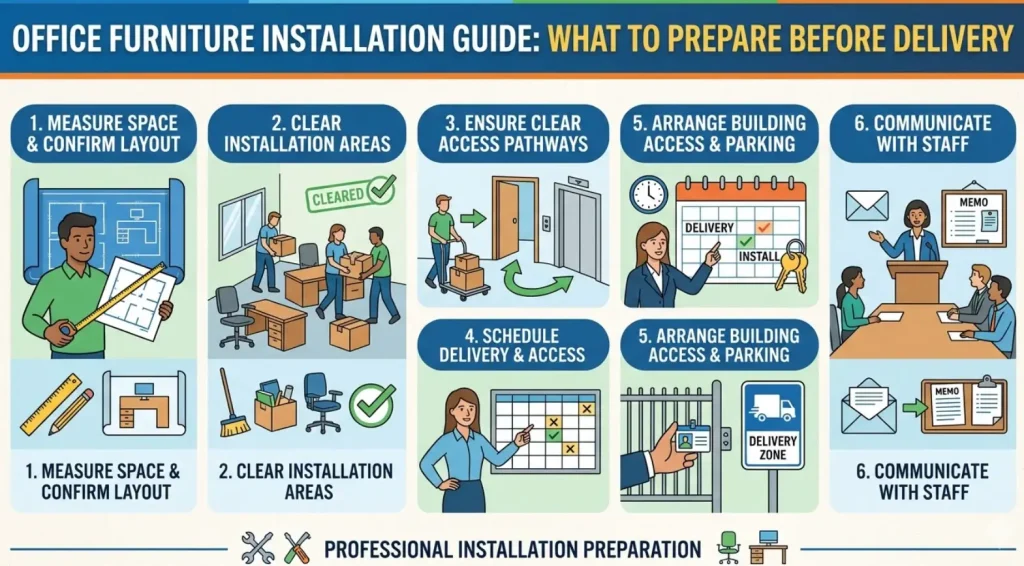
Why Pre-Installation Planning Matters
Many businesses overlook the preparation phase entirely. They focus heavily on selecting ergonomic chairs, height-adjustable desks, or modular workstations — then scramble once the truck arrives. The reality is that professional furniture installation is a process that starts well before the first bolt is turned.
Poor planning leads to delayed timelines, scratched flooring, incorrect placements, and, in some cases, furniture that simply won’t fit through doorways. A structured pre-delivery checklist eliminates these risks and ensures your commercial office furniture setup runs efficiently.
Step 1: Measure Your Space Accurately
The foundation of any successful office furniture installation is precise measurement. Before delivery, take accurate dimensions of:
- Room length, width, and ceiling height
- Doorway and corridor widths (especially for large items like executive desks or conference room furniture)
- Elevator dimensions if you’re above the ground floor
- Stairwell width and turning radius for multi-story buildings
Use a laser measuring tool for accuracy and map your floor plan digitally or on paper. Mark where electrical outlets, HVAC vents, and data ports are located — these affect where workstations and cable management systems can be positioned.
Step 2: Clear and Protect the Path
On installation day, your installers need a clear, safe path from the entrance to the workspace. Prepare by:
- Removing existing furniture or relocating it temporarily
- Protecting flooring with moving blankets, cardboard, or floor film — especially important for hardwood and tile surfaces
- Taping off elevator buttons and door frames to prevent scuffs during furniture delivery and assembly
- Ensuring hallways are free from boxes, décor, or obstructions
If you’re in a multi-tenant building, confirm with building management whether a loading dock reservation or freight elevator booking is required. Many buildings have strict delivery windows.
Step 3: Review Your Furniture Order in Detail
Before your installation team arrives, review your complete order against the purchase invoice. Confirm:
| Item to Verify | What to Check |
|---|---|
| SKU and model numbers | Match the purchase order exactly |
| Quantity of each piece | Desks, chairs, filing cabinets, shelving |
| Hardware and accessories | Included bolts, brackets, and cable trays |
| Finish and colour | Correct fabric, laminate, or wood tone |
| Assembly instructions | Available for each product |
This step is critical for modular office furniture systems where components are interchangeable. A missing bracket or mismatched panel can halt the entire workstation assembly process.

Step 4: Plan Your Layout Before Installation Day
Don’t wait until furniture arrives to decide where everything goes. Use a space planning tool or floor plan software to pre-arrange your layout. Consider:
- Traffic flow — ensure 36 inches of aisle clearance minimum for ergonomic workspace design
- Natural light — position monitors perpendicular to windows to reduce glare
- Power access — align desks near power strips and data ports
- Collaborative vs. focused zones — open-plan office furniture arrangements should still include quiet areas
Share this layout with your installation team ahead of time. Most professional office furniture installers will follow a pre-approved floor plan, which eliminates back-and-forth on the day.
Industry Data: Furniture Installation Timelines
| Office Size | Estimated Installation Time | Recommended Team Size |
|---|---|---|
| Small (1–5 workstations) | 2–4 hours | 1–2 installers |
| Medium (6–20 workstations) | 1–2 days | 2–4 installers |
| Large (21–50 workstations) | 3–5 days | 4–6 installers |
| Enterprise (50+ workstations) | 1–3 weeks | 6+ with project manager |
According to the Business and Institutional Furniture Manufacturers Association (BIFMA), improper installation accounts for nearly 30% of workplace furniture-related injuries, underscoring the importance of using certified installers and proper pre-installation preparation.
Studies also indicate that businesses that pre-plan their office layout reduce installation time by up to 40%, compared to those who coordinate placement on the day of delivery.
Step 5: Coordinate with IT and Facilities
Office furniture installation rarely happens in isolation. In modern offices, workstations integrate directly with technology infrastructure. Before delivery day:
- Confirm with your IT department that network ports, power outlets, and server access points are active
- Arrange for cable management installation to run alongside furniture setup — not after
- If sit-stand desks or motorised height-adjustable workstations are being installed, confirm power access beneath each unit
- Notify building facilities about any drilling, anchoring, or wall-mounting required
Failing to coordinate these elements often results in a finished desk assembly that requires complete disassembly just to route cables — a costly and avoidable mistake.

Step 6: Prepare for Post-Installation Inspection
Once your office furniture installation is complete, a thorough inspection is essential before signing off. Walk through and check:
- All joints and connections are secure with no wobble
- Drawers and cabinet doors open and close smoothly
- Adjustable furniture components — lumbar supports, armrests, desk heights — function correctly
- No visible damage to surfaces, edges, or upholstery
- Hardware is flush, and all fasteners are tightened
Document any defects with photos immediately. Most commercial furniture suppliers offer a warranty claim window of 24–72 hours post-delivery for visible damage. Acting quickly protects your investment.
Quick Reference: Pre-Delivery Checklist
| Task | Completed? |
|---|---|
| Floor plan finalised and shared with installers | ☐ |
| Room and doorway measurements confirmed | ☐ |
| Delivery path cleared and floor protected | ☐ |
| Order reviewed against the purchase invoice | ☐ |
| IT and facilities teams were notified | ☐ |
| Building management is informed of the delivery window | ☐ |
| Post-installation inspection plan in place | ☐ |
Final Thoughts
A well-executed office furniture installation starts long before the installation crew steps through the door. By measuring accurately, coordinating with the right teams, protecting your space, and verifying your order in advance, you create the conditions for a smooth, efficient setup.
Research from workplace design consultancies consistently shows that ergonomic office environments — when properly installed and arranged — can improve employee productivity by 10 to 15%.
This reinforces that the effort put into pre-installation planning is not just logistical — it’s a direct investment in your team’s performance and wellbeing.
Oakland Furniture specialises in professional office furniture installation, delivering, assembling, and positioning desks, chairs, workstations, and storage units to help businesses create functional, ergonomic, and productive work environments.