

When you order a new desk, ergonomic chair, or full office furniture suite, you’re trusting that what arrives matches exactly what was promised — in finish, function, and durability. But how does a manufacturer ensure that?
The answer lies in a rigorous office furniture quality control process that happens long before any piece leaves the warehouse floor. Understanding this process helps buyers make smarter purchasing decisions and sets realistic expectations for delivery timelines.
What Is Office Furniture Quality Control?
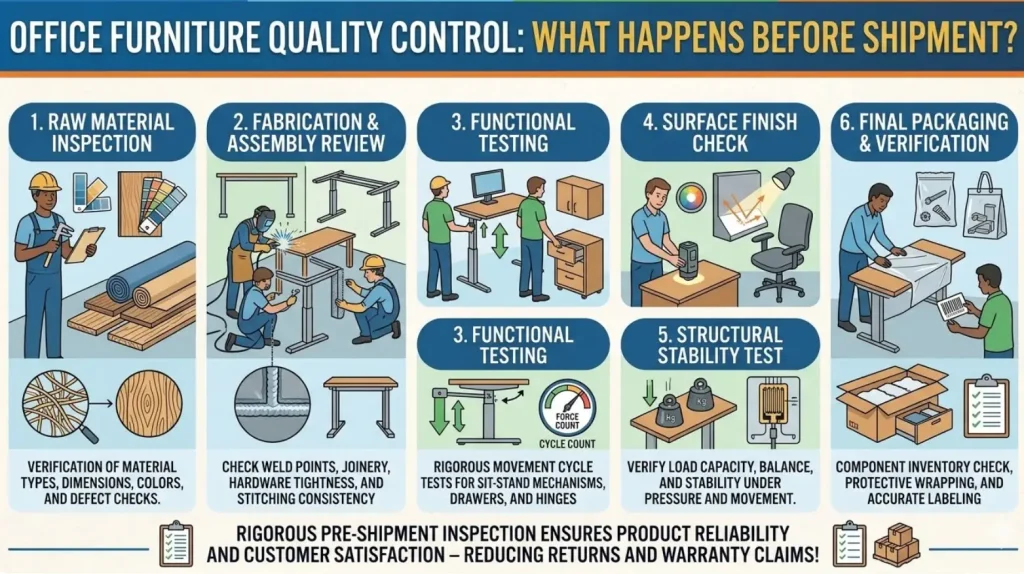
Office furniture quality control is the systematic process of inspecting, testing, and verifying that every furniture piece meets defined manufacturing standards, safety requirements, and customer specifications before shipment.
It spans raw material sourcing, production line checks, finished goods inspection, and pre-shipment verification — forming a complete quality assurance framework that protects both the manufacturer and the end user.
Stage 1: Raw Material Inspection
Quality begins before a single component is assembled. Reputable manufacturers conduct incoming material inspections on every batch of:
- Steel and metal frames — checked for tensile strength, surface coating adhesion, and dimensional accuracy
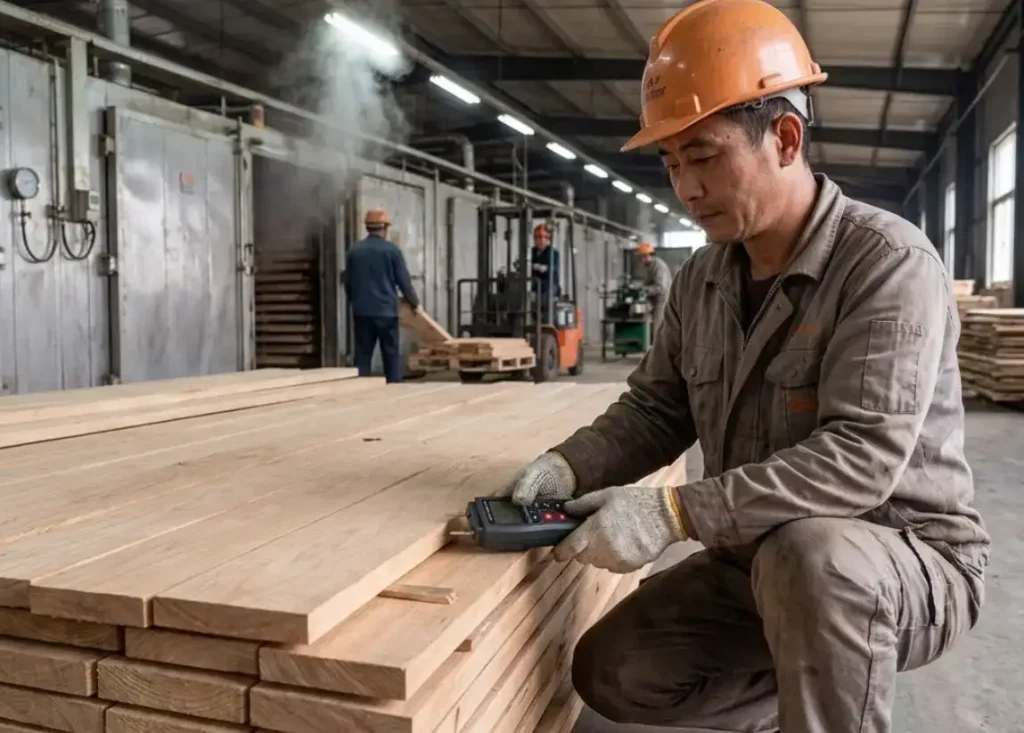
- Wood and engineered panels — tested for moisture content, formaldehyde emission levels, and structural density
- Foam and upholstery fabric — assessed for compression resistance, abrasion rating, and colourfastness
- Plastic components and castors — verified for load-bearing capacity and material consistency
Any material that fails incoming quality control (IQC) standards is rejected before it enters production. This upstream gate is one of the most cost-effective ways to prevent defects downstream.
Stage 2: In-Process Quality Checks
During manufacturing, in-process quality control (IPQC) involves ongoing inspections at critical production stages. For commercial office furniture, this typically includes:
| Production Stage | Quality Check Performed |
|---|---|
| Frame welding or joinery | Weld integrity, squareness, and load testing |
| Surface finishing | Paint adhesion, powder coat thickness, laminate bonding |
| Upholstery and foam fitting | Seam strength, foam density consistency, fabric alignment |
| Hardware and mechanism fitting | Drawer slide smoothness, gas lift function, hinge torque |
| Sub-assembly checks | Panel alignment, pre-drill accuracy, and connector fit |
These checkpoints catch defects at the source, preventing faulty components from advancing further down the production line — a principle central to lean manufacturing quality management.
Industry Data: Furniture Quality Benchmarks
| Quality Metric | Industry Standard | Premium Manufacturer Target |
|---|---|---|
| Surface defect tolerance | ≤ 2 defects per unit | Zero visible defects |
| Dimensional variance | ±3mm | ±1mm |
| Structural load test (desk) | 100kg static load | 150kg+ static load |
| Chair cycle test (BIFMA) | 100,000 cycles | 200,000+ cycles |
| Fabric abrasion (Martindale) | 25,000 rubs | 100,000+ rubs |
According to the Business and Institutional Furniture Manufacturers Association (BIFMA), furniture that passes BIFMA X5.1 and X5.5 certification standards undergoes over 17 individual structural and durability tests, including drop tests, stability assessments, and fatigue cycling.
These standards are widely adopted across North America, Australia, and the UK as the benchmark for commercial-grade office furniture durability.

Stage 3: Finished Goods Inspection
Once manufacturing is complete, every unit — or a statistically representative sample in large-batch production — undergoes a finished goods quality inspection (FQI). This is the most comprehensive stage of office furniture quality control and covers:
- Visual inspection — surface scratches, colour inconsistencies, uneven finishes, or visible manufacturing marks
- Dimensional verification — confirming that height, width, and depth match specification sheets
- Functional testing — opening drawers, adjusting desk heights, reclining chair backs, locking mechanisms
- Assembly fit check — verifying that all components align correctly and hardware fits flush
- Labelling and documentation — checking that model numbers, weight ratings, and assembly instructions are accurate and included
For ergonomic office chairs, finished goods inspection also includes lumbar support adjustment testing, armrest height verification, and seat pan tilt function checks — all critical to the chair performing as advertised in a real workplace environment.
Stage 4: Pre-Shipment Inspection
The final gate before any piece ships is the pre-shipment inspection (PSI) — often conducted by an independent third-party quality inspector, particularly for large commercial orders or international shipments. This stage of office furniture quality control includes:
| Inspection Element | Purpose |
|---|---|
| Random sampling (AQL standard) | Statistically validate batch quality without checking every unit |
| Packaging integrity check | Confirm protective foam, corner guards, and wrapping are adequate |
| Carton drop and compression test | Simulate transit stress to ensure packaging protects contents |
| Quantity and SKU verification | Confirm shipment matches the purchase order exactly |
| Photo documentation | Visual record of condition at point of dispatch |
The Acceptable Quality Level (AQL) sampling method is the global standard used by most furniture manufacturers and importers. Under AQL 2.5 — the most common threshold for commercial furniture procurement — a batch of 500 units would require inspection of at least 50 pieces, with no more than 3 minor defects permitted before the shipment is cleared.
Stage 5: Packaging and Transit Protection
Even a perfectly manufactured piece can arrive damaged without proper protective packaging standards. Quality-conscious manufacturers invest heavily in:
- Custom-formed foam inserts shaped to protect corners, legs, and glass surfaces
- Corrugated double-wall cartons rated for stacking loads during container shipping
- Stretch wrap and edge protectors for flat-pack panel furniture
- Moisture barrier films for shipments travelling through humid climates or extended sea freight
Transit damage is one of the leading causes of furniture quality complaints, which is why pre-shipment packaging validation is treated as an integral part of the broader office furniture quality control process — not an afterthought.
What Certifications Should You Look For?
When evaluating suppliers, these certifications signal a credible furniture quality management system:
| Certification | What It Validates |
|---|---|
| BIFMA X5.1 / X5.5 | Seating and desk structural durability (North America) |
| ISO 9001:2015 | Quality management systems across manufacturing operations |
| GREENGUARD Gold | Low chemical emissions — critical for indoor air quality compliance |
| AS/NZS 4438 | Height-adjustable desks standard (Australia/New Zealand) |
| EN 1335 | Office seating safety and durability (Europe) |
A supplier holding ISO 9001:2015 certification has demonstrated that their entire quality management process — from supplier audits to customer complaint handling — meets internationally recognised standards.
For buyers procuring large volumes of workstation furniture or seating solutions, this certification significantly reduces supply chain risk.
A Global Perspective on Quality Standards
Research published by the International Organisation for Standardisation (ISO) indicates that manufacturers operating under certified quality management systems report up to 50% fewer product defect complaints compared to non-certified producers.
In the office furniture sector specifically, companies that invest in end-to-end quality control processes — from raw material IQC through to pre-shipment PSI — experience significantly lower return rates, reduced warranty claims, and stronger long-term customer retention.
This data reinforces why office furniture quality control is not simply a compliance exercise, but a core business strategy that directly impacts profitability and brand reputation.

Final Thoughts
From the first sheet of steel to the last packaging label, office furniture quality control is a multi-stage discipline that protects your investment and ensures what arrives at your workplace performs exactly as expected.
When evaluating suppliers — whether local or overseas — ask specifically about their IQC, IPQC, and pre-shipment inspection processes. Request certification documentation. Understand their AQL thresholds.
The best commercial office furniture suppliers don’t just build good products — they build systems that consistently deliver good products, every shipment, every time.
Oakland Furniture delivers office furniture quality control at every stage of production — from raw material inspection and in-process checks to pre-shipment testing — ensuring every desk, chair, and workstation meets strict durability, safety, and ergonomic standards before it reaches your workplace.