

When selecting metal office furniture — from steel-frame desks to aluminum storage cabinets — the finishing process applied to the metal surface plays a decisive role in long-term performance. Two methods dominate commercial furniture manufacturing: powder coating and spray painting.
Understanding the differences between powder coating vs spray painting helps procurement managers, interior designers, and facilities teams specify the right finish for their environment, budget, and durability expectations.
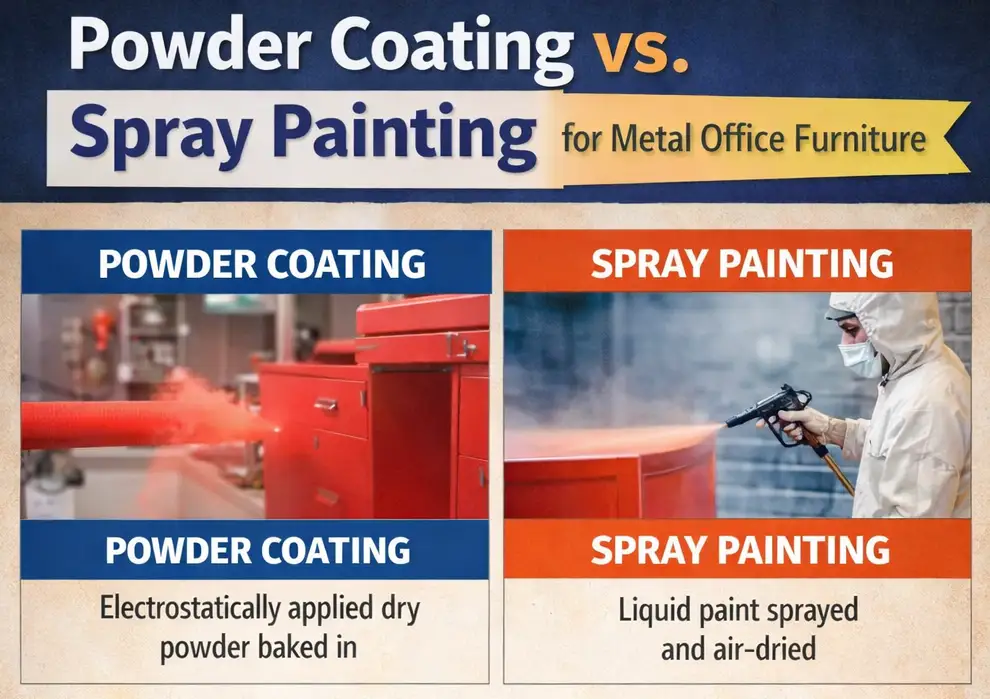
What Is Powder Coating?
Powder coating is a dry finishing process in which electrostatically charged powder particles — composed of thermosetting or thermoplastic polymer resins, pigments, and additives — are sprayed onto a grounded metal substrate.
The coated piece is then cured in an oven at temperatures typically between 160°C and 200°C (320°F–392°F), causing the powder to melt, flow, and chemically cross-link into a hard, continuous film.
The result is a dense, uniform coating that bonds directly to the metal surface without requiring a solvent carrier. This gives powder-coated finishes their characteristic thickness, toughness, and resistance, making them a preferred choice in commercial office furniture production.
What Is Spray Painting for Metal Furniture?
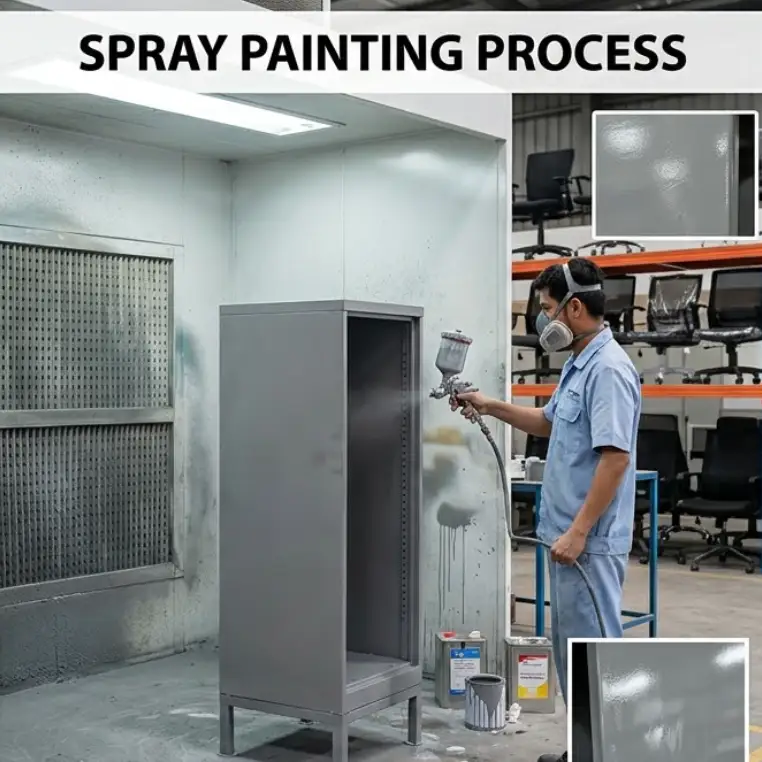
Liquid spray painting — also referred to as wet spray finishing — applies a solvent-based or water-based paint in liquid form using spray guns, either manually or through automated systems. The coating dries through solvent evaporation and, in the case of two-component systems, through a chemical curing reaction between a resin and a hardener.
In office furniture manufacturing, epoxy spray paint, polyurethane topcoat, and acrylic enamel are the most commonly used liquid coatings on metal substrates. Each offers different balances of hardness, flexibility, and chemical resistance.
Powder Coating vs Spray Painting: A Direct Comparison
| Performance Factor | Powder Coating | Spray Painting |
|---|---|---|
| Film Thickness | 60–120 microns (single pass) | 25–75 microns (multiple coats) |
| Surface Hardness | Pencil hardness H–3H | Pencil hardness F–2H |
| Impact Resistance | Excellent — flexible under stress | Moderate — can chip on impact |
| Scratch Resistance | Very High | Moderate |
| Corrosion Resistance | Superior — no pinholes or runs | Good — dependent on application quality |
| Color Consistency | Very High — batch-stable | Moderate — prone to overspray variation |
| VOC Emissions | Near zero | Low to High (solvent-dependent) |
| Cure Time | 15–30 min (oven cure) | 30 min–24 hrs (air dry or force dry) |
| Finish Uniformity | Excellent | Good (skilled operator dependent) |
| Rework Complexity | Requires full strip and recoat | Easier spot repair |
| Cost per Unit | Higher upfront, lower lifecycle | Lower upfront, higher maintenance |
| Environmental Compliance | LEED, REACH, RoHS friendly | Depends on formulation |
Durability: Why Powder Coating Leads in Commercial Environments
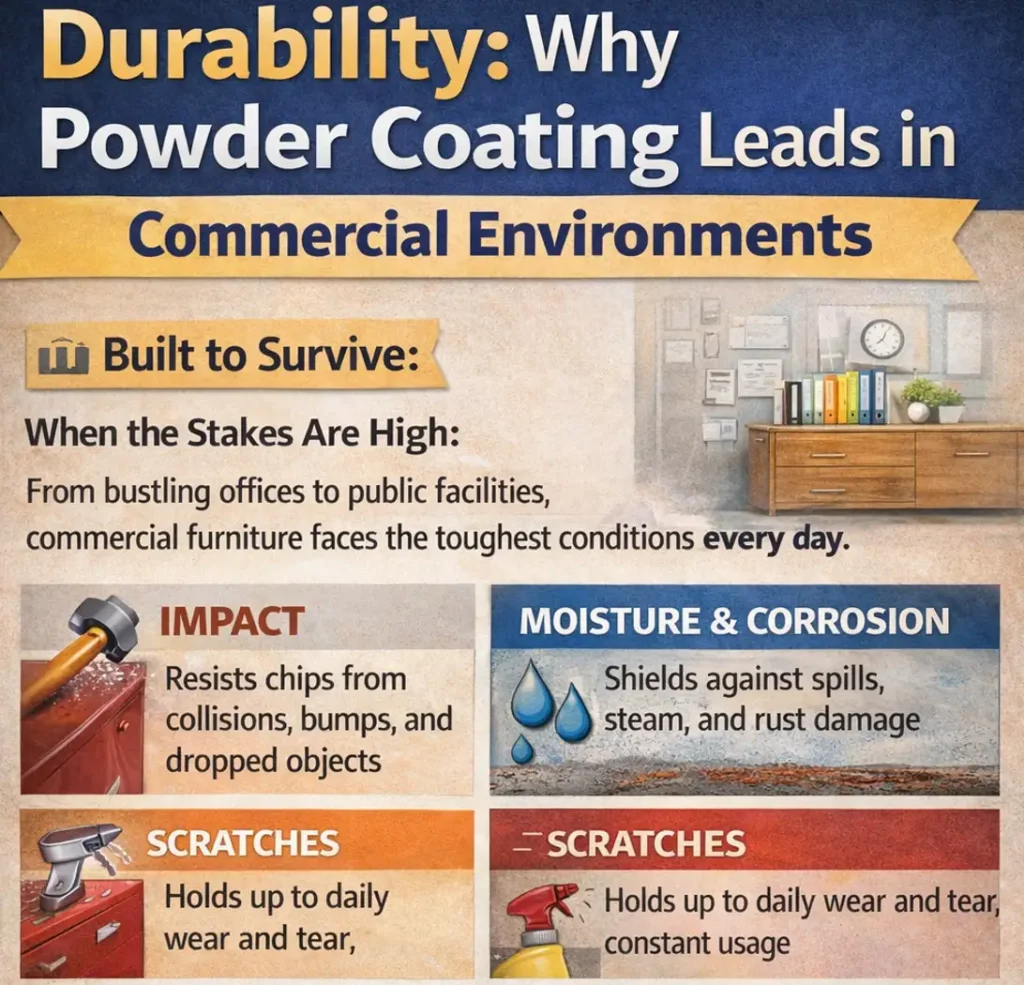
In the context of powder coating vs spray painting, durability is the most frequently cited differentiator. Electrostatic powder coating creates a coating that is chemically bonded to the substrate rather than simply adhering to the surface. This means the finish resists:
Chipping and Impact Damage — Office furniture experiences constant mechanical contact. Chair legs strike desk frames, filing drawers are slammed, and storage units are loaded and unloaded repeatedly. The cross-linked polymer matrix of a cured powder coat absorbs and distributes impact energy more effectively than liquid paint films.
Corrosion and Oxidation — For steel-frame furniture in humid climates or environments with frequent cleaning, corrosion resistance is critical. Powder coating’s uniform film thickness — free of the pinholes and thin spots common in liquid spray applications — provides a more consistent barrier against moisture ingress.
Abrasion and Scratch Resistance — High-traffic office environments expose furniture surfaces to abrasive contact daily. Powder-coated surfaces consistently outperform liquid spray finishes in Taber abrasion resistance testing, a standard method used to quantify coating wear in commercial furniture qualification.
Industry Data on Finish Performance
| Test Method | Powder Coated Result | Liquid Spray Paint Result |
|---|---|---|
| Salt Spray (ASTM B117) | 500–1,000+ hours | 250–500 hours |
| Taber Abrasion (CS-17 wheel) | 10–20 mg loss per 1,000 cycles | 25–50 mg loss per 1,000 cycles |
| Cross-Hatch Adhesion (ASTM D3359) | 5B (no removal) | 3B–4B (slight removal at intersections) |
| Impact Resistance (ASTM D2794) | 80–160 in-lb direct impact | 40–80 in-lb direct impact |
| Pencil Hardness (ASTM D3363) | H – 3H | F – 2H |
These figures reflect typical performance benchmarks used in BIFMA-compliant furniture testing and major commercial procurement specifications. Buyers sourcing large volumes of office furniture should request third-party test reports aligned with these standards.
Environmental and Health Considerations
The environmental profile of powder coating vs spray painting has become increasingly relevant as corporate sustainability programs and green building certifications raise the bar for material specifications.
Powder coating produces near-zero volatile organic compound (VOC) emissions during application and curing. Overspray can be collected and reused, making material utilization rates extremely high — often exceeding 95%. This aligns with LEED v4 Low-Emitting Materials credits and supports WELL Building Standard requirements for indoor air quality.
Liquid spray painting with solvent-based formulations generates significant VOC emissions, which require industrial exhaust systems, worker respiratory protection, and compliance with EPA NESHAP regulations or regional equivalents.
Water-based spray systems reduce VOC levels substantially but generally sacrifice some degree of coating hardness and chemical resistance compared to solvent systems.
For organizations with ESG reporting obligations or green procurement mandates, specifying electrostatically applied powder coating on metal office furniture is the cleaner, more defensible choice.
Where Spray Painting Still Holds Advantages
Despite powder coating’s performance edge, liquid spray painting retains legitimate advantages in specific scenarios:
Complex or Heat-Sensitive Assemblies — Components that cannot withstand oven temperatures — such as those incorporating plastic parts, pre-assembled electronics, or wood elements — cannot be powder coated after assembly. Spray painting allows finishing of fully assembled or partially assembled furniture without thermal risk.
Custom Color Matching and Gradients — Liquid spray systems offer greater flexibility for RAL custom color matching, gradient finishes, metallic effects, and multi-tone decorative coatings that are difficult or impractical to achieve with powder.
For bespoke boardroom furniture or branded workplace environments requiring precise color identity, spray painting provides more creative latitude.
Repair and Touch-Up — Powder coating cannot be spot-repaired in the field. A scratched or chipped powder coat requires stripping the affected area and recoating under controlled factory conditions. Liquid paint enables on-site touch-up application, which is valuable for high-turnover commercial spaces where minor surface damage is routine.
Choosing the Right Finish for Your Office Furniture Project
| Project Requirement | Recommended Finish |
|---|---|
| High-volume workstation procurement | Powder Coating |
| LEED or WELL certified building | Powder Coating |
| Coastal or high-humidity environment | Powder Coating |
| Custom color or gradient branding | Liquid Spray Paint |
| Heat-sensitive or pre-assembled units | Liquid Spray Paint |
| Budget-constrained initial procurement | Liquid Spray Paint |
| Long-term lifecycle cost priority | Powder Coating |
| Field repair capability required | Liquid Spray Paint |
Surface Preparation: The Common Foundation
Regardless of which finish is selected, metal surface preparation is the single most important factor in coating adhesion and longevity. Both powder coating and spray painting require thorough degreasing, phosphate conversion coating or chromate treatment, and in many cases, shot blasting or sandblasting to create an anchor profile on the metal substrate.
Skipping or abbreviating surface preparation is the primary cause of premature coating failure in metal office furniture — regardless of whether the topcoat is powder or liquid. Reputable manufacturers document their pre-treatment processes and should be able to provide process specifications on request.
Conclusion
The debate around powder coating vs spray painting for metal office furniture is not simply a matter of aesthetics — it is a decision with measurable consequences for durability, environmental compliance, lifecycle cost, and maintenance burden.
For most commercial office furniture applications, powder coating delivers superior long-term performance, lower VOC output, and better resistance to the mechanical and environmental stresses of daily use.
Liquid spray painting remains a strong choice for custom applications, heat-sensitive assemblies, and projects where field repairability or creative flexibility is a priority. Understanding both processes in depth ensures that finish specifications align with the full requirements of the project — not just the initial purchase price.