

Office furniture project management is far more than choosing desks and chairs. It is a structured discipline that coordinates budgets, timelines, vendors, spatial planning, and stakeholder communication from the first client brief through to the final installation sign-off.
Whether you are outfitting a 10-person startup or a 5,000-seat corporate headquarters, the principles of furniture project management remain the same: plan thoroughly, communicate consistently, and execute with precision.
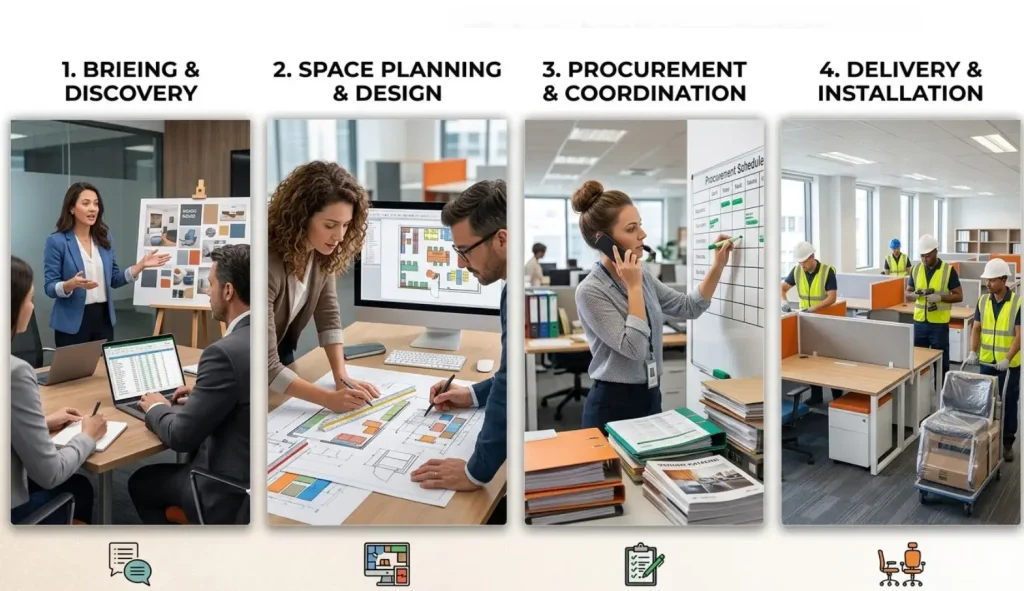
Phase 1: The Client Brief and Needs Assessment
Every successful office furniture project begins with a comprehensive brief. At this stage, the project manager works closely with the client to define scope, budget constraints, brand requirements, and workplace design goals.
Key questions include: How many workstations are needed? What ergonomic standards must be met? Are there sustainability or LEED certification requirements? Does the layout need to support activity-based working or a more traditional fixed-desk model?
A thorough space planning analysis follows, using CAD drawings or BIM (Building Information Modelling) software to map furniture layouts against the physical footprint of the office. This step prevents costly mistakes downstream — a common cause of project delays is discovering that a selected product line does not fit the available floor plan.
Phase 2: Procurement, Vendor Selection, and Lead Times
| Stage | Key Activities | Typical Duration |
|---|---|---|
| Vendor Shortlisting | RFP/RFQ, showroom visits, product testing | 2–4 weeks |
| Specification Sign-off | Client approval on materials, finishes, and fabrics | 1–2 weeks |
| Purchase Order Placement | Order submission to manufacturers | 1 week |
| Manufacturing Lead Time | Standard products vs. bespoke/custom items | 6–20 weeks |
| Logistics & Warehousing | Freight, storage, pre-delivery inspection | 2–4 weeks |
| Installation & Snagging | Delivery, assembly, defect resolution | 1–3 weeks |
Procurement management is one of the most technically demanding phases of office furniture project management. The project manager must balance cost-efficiency with quality, manage supply chain risks, and align delivery windows with the construction or fit-out programme.

Choosing between global contract furniture manufacturers and local suppliers involves weighing lead times, after-sales support, and warranty management considerations.
Phase 3: Stakeholder Communication and Change Management
A hallmark of professional office furniture project management is proactive stakeholder engagement. End-users, HR teams, IT departments, facilities managers, and senior leadership all have different priorities. The project manager serves as the single point of contact who translates technical specifications into language that each audience understands.
Change management in furniture projects is frequently underestimated. When employees transition from private offices to open-plan workspaces or hot-desking environments, there can be significant resistance.
Building a change management communication plan — including town halls, sample room displays, and feedback surveys — dramatically improves adoption rates and satisfaction scores post-installation.
| Key Industry Data | Detail |
|---|---|
| Average office refurbishment cycle | Every 7–10 years for mid-to-large enterprises |
| Furniture as a share of fit-out costs | Typically, 25–35% of the total office fit-out budget |
| Lead time for bespoke upholstered items | Commonly 16–20 weeks from order |
| Common cause of project overrun | Specification changes after purchase order placement |
| Ergonomic compliance standard (EU) | EN 527 for office desks; EN 1335 for office chairs |

Phase 4: Logistics, Delivery Coordination, and Risk Management
Logistics planning is a critical but often overlooked element of office furniture project management. Coordinating multiple vendor deliveries into a single building — often while other trades are still working — requires a detailed delivery programme and close liaison with the building management team.
Risk management at this stage involves anticipating delays, damaged goods, and access restrictions. Experienced project managers maintain a contingency budget (typically 5–10% of the furniture spend) and have pre-agreed escalation protocols with suppliers. Pre-delivery inspections (PDI) at the warehouse help catch defects before items reach the site, reducing costly re-delivery cycles.
Sustainable disposal of existing furniture is increasingly part of the brief. Circular economy principles are shaping how organisations approach furniture decommissioning, with options including resale, charity donation, upcycling, or certified recycling to support ESG reporting goals.

Phase 5: Installation, Snagging, and Handover
The installation phase is where planning meets reality. A structured installation management process includes a method statement, a trained and supervised installation crew, and a clear snagging protocol for identifying and rectifying defects on the day.
A photographic record of completed areas provides accountability and serves as evidence for insurance or warranty claims.
Post-installation, the project manager conducts a formal handover meeting with the client, presenting the asset register, warranties, care and maintenance guides, and any outstanding action items. A post-occupancy evaluation (POE) conducted 4–8 weeks after handover gives valuable feedback on whether the workplace strategy has delivered the intended outcomes.
| Key Industry Data | Detail |
|---|---|
| Post-occupancy evaluation timing | Recommended 4–8 weeks after installation |
| Snagging resolution target | Industry benchmark: 95%+ resolved within 5 working days |
| Average furniture lifespan | 10–15 years for quality contract-grade products |
| Digital tools adoption | Over 60% of large fit-out projects now use BIM or 3D visualisation |
| Employee satisfaction impact | Well-designed workplaces can improve productivity by up to 20% (CBRE, 2023) |
Conclusion
Effective office furniture project management demands a blend of commercial acumen, technical knowledge, and interpersonal skills. From the initial needs assessment through space planning, procurement, logistics coordination, and final installation management, every phase depends on disciplined processes and clear communication.
Organisations that invest in professional furniture project management consistently achieve better outcomes — on budget, on schedule, and with workspaces that genuinely support the way their people work.
Oakland Furniture is a China-based contract furniture manufacturer and supplier specializing in high-quality office furniture solutions, supporting professionals throughout every stage of office furniture project management — from initial space planning and procurement to logistics coordination and final installation.