

Writing a precise office furniture specification is the foundation of every successful commercial fit-out. Whether you are an interior designer, facilities manager, procurement officer, or workplace consultant, a well-structured specification document eliminates ambiguity, protects budgets, and ensures that every product delivered to the site meets the agreed standard.
Without it, projects are exposed to substitution risk, quality disputes, and costly snagging. This guide walks you through exactly how to build a robust office furniture specification from the ground up.
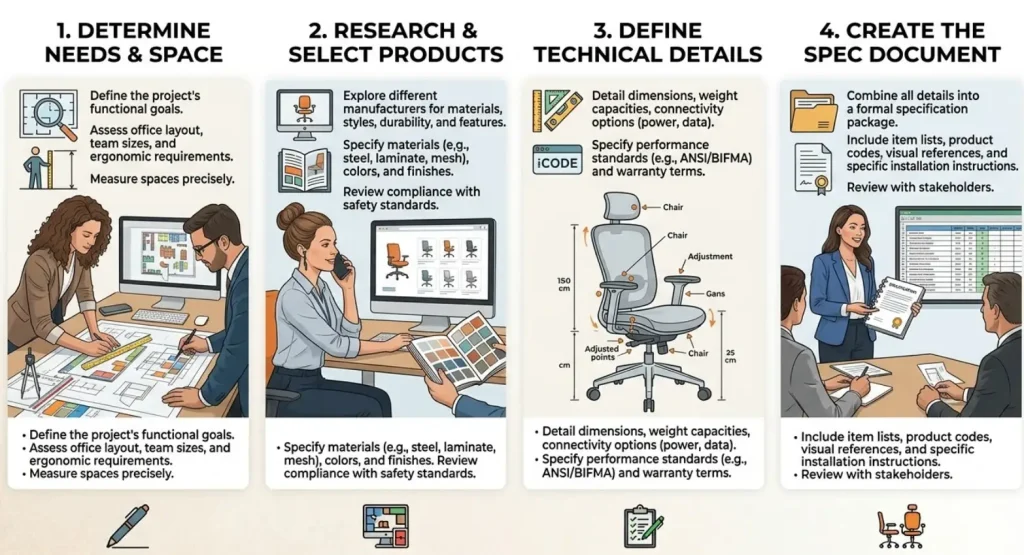
What Is an Office Furniture Specification?
An office furniture specification is a formal technical document that defines the exact products, materials, finishes, performance standards, and delivery requirements for a commercial furniture project. It forms part of the wider contract documentation and is used by procurement teams, suppliers, and installers as the single source of truth throughout the project lifecycle.
A strong specification does three things: it communicates the design intent, establishes measurable quality standards, and provides a legal reference point if disputes arise. It is distinct from a mood board or a furniture schedule — it goes deeper, capturing the technical and commercial detail that those documents omit.
Step 1: Define the Project Scope and User Requirements
Before writing a single product line, you must understand the end-user requirements and the operational context of the space. Key questions include:
How many people will use the space? What work modes need to be supported — focused work, collaboration, video conferencing, or activity-based working? Are there specific accessibility requirements under the Equality Act or ADA? What are the ergonomic standards the client expects, such as EN 1335 for seating or EN 527 for desking?
This stage also captures brand and aesthetic parameters: colour palettes, material preferences, and any mandatory supplier relationships the client already holds. Document these as fixed constraints before the specification writing begins.
Step 2: Structure Your Specification Document
A professional commercial furniture specification follows a logical structure that mirrors the procurement and installation process. A recommended framework includes:
| Section | Content |
|---|---|
| Project Overview | Client name, site address, project reference, revision history |
| Scope of Works | Areas covered, product categories included/excluded |
| Standards & Compliance | Relevant BS/EN standards, fire ratings, and sustainability certifications |
| Product Specifications | Item-by-item technical detail: dimensions, materials, finishes, mechanisms |
| Performance Requirements | Load ratings, durability testing, and warranty expectations |
| Delivery & Installation | Packaging, access requirements, installation method, snagging protocol |
| Substitution Policy | Conditions under which equivalent products may be proposed |
| Commercial Terms | Pricing format, lead time expectations, payment milestones |
This structure ensures that every stakeholder — from the procurement manager to the installation crew — can navigate the document and find the information relevant to their role.
Step 3: Writing the Product Specification Entries
The core of any office furniture specification is the product entry. Each item should be described with enough technical precision that a competent supplier can price and supply it without ambiguity, and that you can verify compliance on delivery.
A complete product entry includes the product name and manufacturer reference, overall dimensions (H x W x D in millimetres), material specification (steel gauge, timber grade, upholstery fabric composition and weight), surface finish (powder coat colour referenced to RAL or BS4800, veneer species and cut, laminate code), mechanism detail (seat height adjustment range, back recline tension, cable management routing), weight capacity, and applicable test standards passed (e.g., BIFMA X5.1 for seating, EN 15372 for tables).
Avoid vague language. Phrases like “high-quality fabric” or “durable finish” are unenforceable. Replace them with measurable criteria: “upholstery fabric minimum 100,000 Martindale rub count, Class 1 fire rating to BS 5852.”
| Key Industry Data | Detail |
|---|---|
| Most common specification error | Insufficient material and finish detail, leading to substitution disputes |
| Upholstery durability benchmark | Minimum 100,000 Martindale rubs for heavy commercial use |
| Standard office desk height range | 680–820mm (height-adjustable); 730mm fixed (EN 527) |
| Fire rating requirement (UK commercial) | Crib 5 (BS 5852) for upholstered seating in most commercial settings |
| Typical specification document length | 20–60 pages, depending on project scale and product categories |
Step 4: Compliance, Sustainability, and Certifications
Modern commercial furniture specifications must address sustainability credentials and environmental standards with increasing rigour. Clients with ESG commitments, BREEAM targets, or LEED certification requirements will expect the specification to reference relevant certifications.
Key certifications to consider including in your furniture specification framework include FSC or PEFC chain of custody for timber products, Greenguard Gold for low VOC emissions (important for indoor air quality), ISO 14001 environmental management certification from manufacturers, and EPD (Environmental Product Declarations) for carbon transparency.

For seating specifically, ergonomic compliance is non-negotiable in most commercial projects. Specifying conformance to EN 1335 Parts 1, 2, and 3 — covering dimensions, safety, and test methods — provides a clear, auditable standard that protects both the specifier and the end-user.
Flame retardancy requirements vary by building type and jurisdiction. In the UK, office seating in most commercial environments must meet BS 5852 Crib 5, while contract loose furniture in higher-risk environments may require Crib 7 compliance. Always confirm requirements with the building’s fire risk assessor before finalising the specification.
Step 5: Managing Substitutions and Equivalents
One of the most commercially sensitive aspects of office furniture specification writing is the substitution clause. In competitive tendering, suppliers will frequently propose equivalent products from alternative manufacturers to improve their margin. Without a clear substitution policy, this can result in a delivered project that bears little resemblance to the design intent.
Best practice is to specify a named product as the basis of design, then define the criteria an equivalent must meet to be considered acceptable. These criteria should reference measurable attributes — dimensions within a defined tolerance, the same or higher test standard performance, matching lead time windows, and equivalent or better warranty terms.
A formal approval process for substitutions — requiring written sign-off from the specifier or client before any alternative is accepted — protects design integrity and gives the project team commercial leverage in supplier negotiations.
| Key Industry Data | Detail |
|---|---|
| Substitution rate on competitive tenders | Suppliers propose alternatives on up to 40% of specified items in open tenders |
| BIFMA certification scope | Covers seating, desking, storage, and panel systems for North American commercial use |
| Greenguard Gold VOC threshold | Among the strictest indoor air quality standards globally for furniture |
| Average warranty on contract seating | 5–10 years for leading contract manufacturers |
| Specification revision cycles | Major revisions typically triggered at RIBA Stage 3 and Stage 4 |
Step 6: Coordinating the Specification with the Wider Project Team
An office furniture specification does not exist in isolation. It must be coordinated with the interior design drawings, the MEP (mechanical, electrical, and plumbing) information, and the building contractor’s programme.

Power and data integration in furniture — particularly in sit-stand desks, collaboration tables, and pod seating — requires close coordination with the electrical contractor to ensure floor boxes, dado trunking, and cable routes align with the furniture layout.
Space planning drawings should reference the specification by product code, creating a direct link between the furniture layout plan and the technical document. This cross-referencing discipline prevents the common problem of a layout evolving during the project without corresponding updates to the specification.
Conclusion
A rigorous office furniture specification is not bureaucracy — it is protection. It protects the client’s investment, the designer’s intent, and the supplier’s ability to price and deliver accurately. By following a structured approach — from user requirements and compliance standards through to substitution management and cross-disciplinary coordination — you create a document that drives consistent, high-quality outcomes on every commercial project.
The time invested in writing a precise office furniture specification is always repaid many times over during procurement, installation, and beyond.
Oakland Furniture is a trusted Chinese contract furniture manufacturer whose products are engineered to meet the rigorous demands of a commercial office furniture specification — delivering certified quality, precise dimensions, and verified compliance standards from initial brief through to final installation.